
Step-by-Step Pathway to Become a Cybersecurity Curriculum Developer
A cybersecurity curriculum developer is the person who turns messy real world threats into clear lessons that actually build job ready skills. In 2026, this role is exploding because companies cannot hire fast enough and training programs keep shipping graduates who can recite terms but cannot investigate or respond. If you can design learning pathways that produce competent SOC analysts, incident responders, or ethical hackers, you become a force multiplier. This step by step guide shows exactly how to break into curriculum development, build proof fast, and create materials employers trust.
1: What a Cybersecurity Curriculum Developer Really Does (And What Makes You Valuable)
A curriculum developer is not a “content writer.” You are a product builder for learning. Your output is a full pathway that takes someone from zero to capability, with measurable outcomes, labs, assessments, and a skill progression that mirrors real work.
Here is what separates high paid curriculum developers from people who just make slides:
You map roles to skills, then skills to evidence. A curriculum that claims to teach SOC work must reflect real SOC tasks like alert triage, log correlation, and incident documentation. If you have never studied how SOC roles evolve, start by reading about the career path from SOC analyst to SOC manager and the actual responsibilities behind that promotion ladder.
You build learning around real attack chains. A student should understand how phishing becomes credential theft, then privilege escalation, then ransomware. Use threat research like the phishing attacks trends report, the state of ransomware threat analysis, and response structure from an incident response plan.
You teach detection thinking, not tool clicking. Tools change. Concepts and workflows last. A modern curriculum should cover SIEM, endpoint telemetry, and log logic using a base like SIEM overview fundamentals and expand into how defenses are measured in the state of endpoint security research.
You design assessments that prove competence. A curriculum developer must write rubrics, scenario prompts, and graded tasks that produce evidence a student can do the job. This matters because hiring managers are tired of certificates that do not translate into performance. If you want to understand what hiring funnels value, study the technical depth behind the step by step CEH pathway and how skills expand as you move from junior penetration tester to senior security consultant.
You align content with frameworks and compliance reality. A curriculum that ignores governance will fail in regulated industries. Use adoption patterns like the NIST framework adoption analysis and real compliance pressure from cybersecurity compliance trends.
If you can do these five things, you can build programs that people trust. Trust is the currency of education in cybersecurity.
| Step | What You Build | Deliverable Proof | Why It Matters | Best ACSMI Topic to Anchor |
|---|---|---|---|---|
| 1 | Pick 1 target job role | Role skills map | Stops vague curricula | SOC role ladder |
| 2 | Define measurable outcomes | Outcome list with verbs | Makes assessments possible | SIEM + IR tasks |
| 3 | Map threats to lessons | Threat to module matrix | Keeps content real | Phishing + ransomware |
| 4 | Choose 10 core concepts | Concept list | Avoids tool worship | Encryption + PKI |
| 5 | Write a module blueprint | Standard lesson template | Scales your output | IR playbooks |
| 6 | Build lab environments | Lab guide + safety rules | Hands on credibility | IDS + firewall labs |
| 7 | Design 1 capstone scenario | Scenario prompt pack | Shows job readiness | Ransomware IR |
| 8 | Create graded rubrics | Rubric with pass criteria | Stops subjective grading | IR documentation |
| 9 | Write quizzes that test reasoning | Question bank | Prevents memorization | CTI analysis |
| 10 | Add real data artifacts | Sample logs and tickets | Makes practice realistic | Data breach case study |
| 11 | Build a syllabus roadmap | 12 week plan | Shows learning progression | SIEM to SOAR flow |
| 12 | Create a content style guide | Voice, format, terms | Keeps quality consistent | Framework mapping |
| 13 | Add compliance alignment | Control mapping sheet | Makes it enterprise ready | NIST + GDPR |
| 14 | Teach data protection skills | DLP mini module | Stops exfil failures | DLP strategy |
| 15 | Add threat intel workflows | Intel to detection lab | Builds proactive mindset | CTI collection |
| 16 | Build 3 portfolio artifacts | Git style pack | Hiring proof | SIEM, IR, phishing |
| 17 | Pilot with 10 learners | Feedback log | Proves usability | SOC workflow |
| 18 | Fix common confusion points | Revision notes | Increases completion | Encryption + VPN |
| 19 | Add instructor notes | Teaching guide | Makes delivery easier | Firewall + IDS |
| 20 | Create hiring aligned outcomes | Competency checklist | Employer trust | CISO roadmap |
| 21 | Build evaluation metrics | KPIs for training | Shows ROI | Market outlook |
| 22 | Package as a course bundle | Module index | Ready to sell | Top companies list |
| 23 | Add updates cadence | Quarterly refresh plan | Keeps it current | AI in security |
| 24 | Create a pitch deck | Program proposal | Wins contracts | Compliance trends |
| 25 | Build a sample lesson demo | 15 minute micro lesson | Shows teaching ability | DDoS prevention |
| 26 | Publish curriculum portfolio | Portfolio page | Inbound credibility | Cyber market report |
| 27 | Apply to roles or sell B2B | Targeted applications | Turns work into income | MSSP guide |
| 28 | Maintain a threat update loop | Monthly revision notes | Future proofs your curricula | Breach industries report |
2: Step-by-Step Career Path to Become a Cybersecurity Curriculum Developer
This is the exact pathway that works in 2026 because it creates proof fast. You are not asking anyone to “believe” you can design curriculum. You are showing it.
Step 1: Choose a single learner outcome and a single target role
Do not try to teach “cybersecurity” as a whole. Pick one. SOC analyst, junior IR analyst, or entry ethical hacker. The easiest path is SOC because you can anchor content on SIEM fundamentals and real career ladders like SOC analyst to SOC manager.
Define the learner outcome like this: “A learner can triage alerts, validate malicious behavior, document findings, and escalate using an incident response plan.”
Step 2: Build a skills map that mirrors real work
Your skills map should include categories like telemetry, detection logic, investigation workflow, and response writing.
Anchor the “telemetry” layer on practical defensive infrastructure topics such as firewall configurations, IDS deployment, and secure access limitations in VPN security.
Then add modern threat context from research pieces like the data breach industries report and the phishing attacks prevention analysis. The goal is not to quote years. The goal is to map the threat patterns.
Step 3: Create one flagship module that proves you can teach
Your first flagship module should be small but complete. Example:
Module title: “Phishing to Account Takeover: Detection and Response”
Concept anchors: CTI collection, SIEM analysis, IR plan execution
Deliverables you must create:
Learning objectives in measurable verbs
Lesson flow with concepts, examples, and checks
Lab guide with artifacts and expected output
Graded rubric and answer key
This one module becomes your portfolio’s “proof of competence” asset.
Step 4: Build scenario labs around high-frequency incidents
In 2026, training that ignores ransomware is ignoring reality. Build a lab that teaches staging detection and response. Use ransomware detection response and recovery and deepen it with the threat landscape signals in the state of ransomware analysis.
Also build one lab around availability threats using DoS mitigation and one lab around distributed threats using botnets structure and disruption. Employers love curriculum developers who cover availability because most training only covers confidentiality.
Step 5: Add enterprise realism through compliance mapping
Enterprise buyers want proof that training supports governance. Build a control map that links lessons to real expectations using cybersecurity compliance trends, GDPR security best practices, and NIST adoption patterns.
Even if you are not teaching compliance, mapping it shows maturity. It tells employers you understand how training supports audit outcomes.
Step 6: Build a portfolio package that hiring managers can scan fast
Your portfolio should not be a massive PDF. It should be a compact package:
1 page syllabus map
1 flagship module outline
1 lab guide sample
1 rubric sample
1 capstone scenario
Tie these artifacts to real career progression such as security manager to director roadmap and leadership expectations like the CISO pathway. That signals you can design training at multiple levels.
3: Curriculum Design Blueprint That Produces Job-Ready Learners (Not Memorization)
Most cybersecurity education fails because it is “definition heavy” and “workflow light.” The learner collects terms but cannot perform tasks. Here is the blueprint that fixes it.
Start with workflows, then teach concepts only when needed
A SOC workflow might be: ingest alert, validate signal, pivot for context, determine scope, document, and escalate.
You can teach this by grounding it in SIEM workflows and then injecting defensive telemetry sources such as firewall logs and IDS events. Learners should understand why these sources exist and what mistakes cause blind spots.
Use “evidence packs” to train investigation speed
An evidence pack is a curated set of artifacts: event snippets, authentication logs, suspicious process tree, and a short user story. This style trains the skill employers want most: decision speed with evidence.
You can source the “story” patterns from real-world research like the data breach industries report and high-frequency entry paths like the phishing trends analysis.
Make every module produce a measurable output
Example measurable outputs:
A complete incident ticket that follows an incident response plan
A threat intel brief using CTI collection and analysis
A DLP escalation note referencing DLP strategies
A ransomware containment decision based on ransomware response steps
When you design this way, your curriculum becomes evidence-driven. Employers can trust it.
Teach cryptography and identity like a defensive engineer
Curricula often treat encryption as theory. Teach it as operational security. Use PKI components and encryption standards AES RSA and beyond to show how identity, certificates, and encryption decisions appear in incidents.
This makes learners better at understanding why secure channels fail and how attackers abuse trust relationships.
Build for “future trends” without becoming hype
In 2026, AI is now part of defense operations. But curriculum developers must teach it responsibly: what it helps with, what it cannot do, and how to verify outputs. Ground this in adoption reality from AI in cybersecurity research so your content stays credible and not speculative.
4: The Portfolio That Gets You Hired (What to Build in 30–60 Days)
In this career, your portfolio is your resume. If you do not build it, you stay invisible. Here is the simplest portfolio that gets serious attention.
Portfolio Asset 1: Role-based learning map
Create a single page that shows:
Target role
Week-by-week modules
Outcomes per module
Assessment type per module
Anchor your map on realistic role expectations using the SOC analyst to SOC manager roadmap and extend it to longer paths like the CISO career guide so employers see you think in ladders, not random topics.
Portfolio Asset 2: One “best in class” lesson module
Choose a high-demand topic. Great options:
SIEM triage module using SIEM overview
Ransomware response module using ransomware recovery playbook
Threat intel to detection module using CTI analysis
Your module must include objectives, lesson script, practice checks, and “what good looks like.”
Portfolio Asset 3: Lab guide with realistic artifacts
Labs must feel real. Use artifacts that resemble what a SOC sees. Your lab can teach learners to connect phishing to authentication anomalies with help from the phishing trends report. Or teach them to detect availability threats using DoS prevention and botnet disruption.
Include safety notes and clear expected outputs. Employers do not want “unsafe hacking labs.” They want controlled learning.
Portfolio Asset 4: Rubrics and grading logic
A rubric makes you look senior instantly. It shows you can measure capability.
Rubric categories can include:
Evidence quality
Reasoning correctness
Documentation clarity
Escalation correctness based on an incident response plan
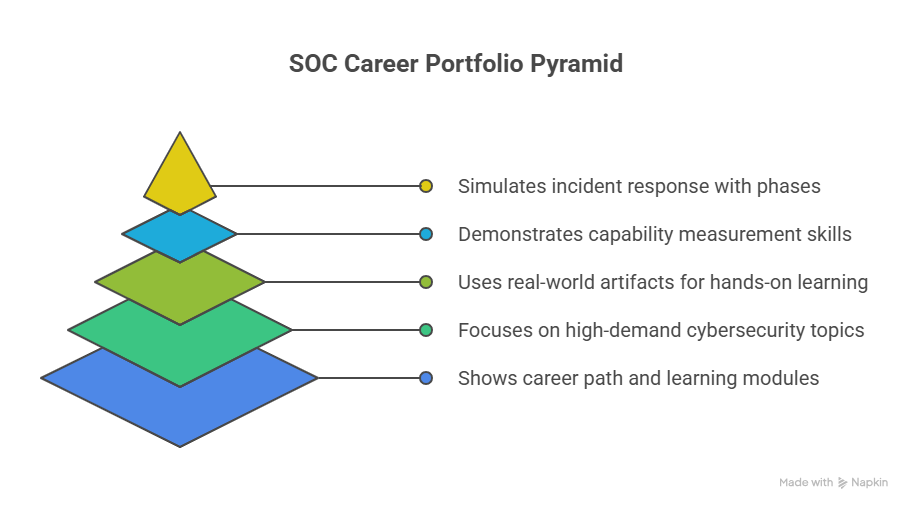
Portfolio Asset 5: Capstone scenario pack
A capstone is a simulated incident with phases. For 2026, a strong capstone is:
Initial phishing event
Credential use anomaly
Lateral movement indicators
Data exfil risk
Response decisions
Tie in DLP choices with DLP strategies and document the response path like a real IR team using the IR plan execution guide.
This portfolio package is small, but it screams competence.
5: How to Get Your First Curriculum Developer Role (Or Your First Paid Contract)
You can enter this career from two directions: internal education teams, or external training providers. Your approach should be based on proof and positioning.
Route 1: Apply to education teams with role-aligned proof
Hiring managers want to see you can design training tied to outcomes. In your application, do not describe your passion. Show your artifacts.
Position your work around high-demand areas that organizations spend money on:
SOC training aligned with SIEM workflows
IR readiness aligned with an incident response plan
Ransomware response aligned with ransomware recovery guidance
Route 2: Sell a small pilot to a training provider or bootcamp
A pilot offer is easier to buy than a full curriculum. Offer a 2-week micro-course or a single module upgrade. Example pilot packages:
“Phishing to ATO module upgrade” anchored on the phishing trends analysis
“SOC alert triage mini-course” anchored on SIEM overview content
“Ransomware containment lab pack” anchored on ransomware response
Route 3: Create a public curriculum sample that attracts inbound
If you publish a clean syllabus and one high-quality module, you attract recruiters and clients. Your content should reflect current themes, including the shift toward AI tooling and its limits, backed by AI adoption research in cybersecurity.
Pricing and positioning reality
Do not position yourself as “beginner curriculum developer.” Position as “role aligned curriculum developer.” Employers and clients pay for outcomes. Tie your work to:
Reduced onboarding time
Fewer incident mistakes
Faster SOC readiness
Better compliance evidence
Those outcomes matter to leaders, including directors on the path described in the security manager to director roadmap and executives following the CISO pathway.
The fastest credibility hack
Build one curriculum module around a topic that is already “board level.” Ransomware and data breaches are perfect because leadership understands the risk. Support your design choices with real landscape reading like the data breach report on at risk industries and the global market outlook. You are not quoting years. You are showing you know the pressure.
6: FAQs About Becoming a Cybersecurity Curriculum Developer
-
No. You need deep understanding of the role you are teaching and the ability to translate it into outcomes, labs, and grading. Many excellent curriculum developers specialize in SOC training using foundations like SIEM workflows and response operations using an incident response plan. If you want to expand into offensive curriculum, studying structured pathways like the CEH guide helps you understand how skills are sequenced.
-
SOC and incident response are the best starting points because demand is high and skills are measurable. You can build strong modules around phishing, SIEM triage, and ransomware response using the phishing trends research, SIEM fundamentals, and ransomware recovery guidance. This specialization also aligns with real career progression like the SOC analyst to SOC manager path.
-
You prove it with outcomes and evidence. Run a pilot with a small group, track assessment results, and show before and after capability. Use structured rubrics tied to tasks in an incident response plan. Add scenario based assessments that reflect real threats described in the data breach industries report and ransomware chain behaviors described in ransomware response content.
-
Teach tool-agnostic workflows first, then pick tools only to demonstrate concepts. For defensive labs, concepts anchored on firewall behaviors, IDS signals, and SIEM correlation stay relevant. For identity and encryption, foundations like PKI and encryption standards remain stable across tools.
-
Build around incidents, not definitions. Every concept should show up inside a scenario with artifacts. Use threats learners actually see such as phishing and ransomware based on the phishing prevention analysis and ransomware response guidance. Then force learners to produce outputs: tickets, escalations, and containment decisions tied back to an IR plan. That method builds memory because it builds skill.
-
Yes, because you learn how teams build capability at scale. Curriculum developers understand skill gaps, operational pain, and workforce readiness. That maps directly into management and strategy paths like security manager to director and executive readiness like the CISO roadmap. If you can prove you can develop people and reduce incident errors, leadership doors open.
-
Sell a small, high-impact deliverable tied to a visible risk. Offer a ransomware response module, a phishing-to-ATO lab pack, or a SOC triage micro-course. Anchor your pitch on strong internal proof assets and connect your module to recognized concepts like SIEM operations, CTI workflows, and incident response planning. Small pilots close faster and create references.
